
Generative AI Automation: Beyond ChatGPT Integration
By Edson Santos • Updated: December 2025
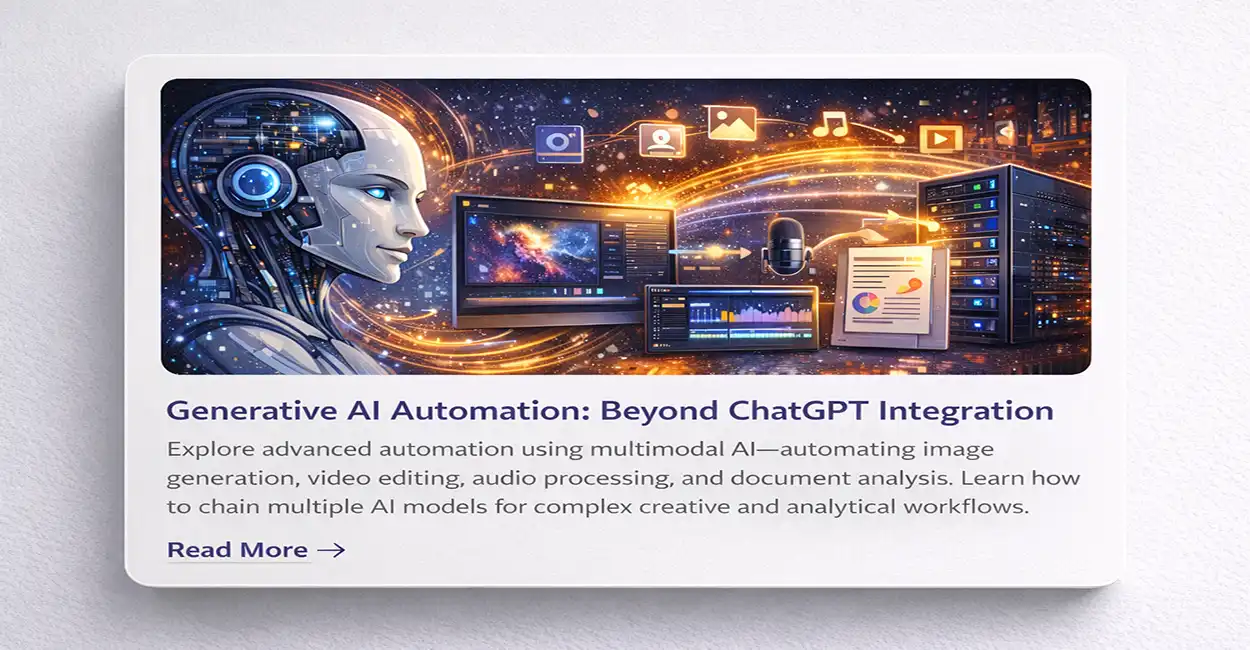
While ChatGPT and similar text-based AI tools have revolutionized content creation, the true power of generative AI automation lies in orchestrating multimodal systems that work across text, images, audio, and video. This represents the next evolutionary leap in automation—moving beyond simple text generation to creating intelligent workflows that understand, transform, and generate content across multiple formats seamlessly. Organizations that master this multidimensional approach are building capabilities that resemble small creative agencies operating at machine speed and scale.
The emergence of platforms that can chain different AI models together has created unprecedented opportunities for automation. Imagine a system where a product description generates corresponding marketing images, which then automatically become social media posts with captions, which then get compiled into performance reports—all without human intervention. This isn't futuristic speculation; it's the current reality for forward-thinking teams leveraging what industry leaders call "AI orchestration platforms." These systems don't just automate tasks; they automate entire creative and analytical processes, freeing human talent for higher-order strategic work.
🎨 Multimodal Automation: The Four Pillars of Modern AI Workflows
True generative AI automation operates across four interconnected content domains, each with specialized models and tools that, when combined, create systems far more capable than any single AI application. Understanding these pillars is essential for designing effective automation architectures.
1. Image Generation & Manipulation
Tools like DALL-E 3, Midjourney, Stable Diffusion, and Adobe Firefly have transformed visual content creation. Beyond generating images from text prompts, advanced automation involves:
- Batch generation of product images with consistent styling
- Automatic background removal and object isolation
- Style transfer across image collections
- Intelligent image upscaling and enhancement
- Automated alt-text generation for accessibility
2. Audio Processing & Synthesis
From voice cloning to sound design, AI audio tools like ElevenLabs, Murf, and Descript enable:
- Text-to-speech with emotional inflection control
- Automatic podcast editing and mastering
- Real-time transcription and translation
- Background noise removal and audio enhancement
- Custom voice model training for brand consistency
3. Video Creation & Editing
Platforms like Runway ML, Pictory, and Synthesia are democratizing video production through:
- Script-to-video automated generation
- Intelligent scene detection and editing
- Automatic caption generation and styling
- Face and object tracking for consistent branding
- AI-powered special effects and transitions
4. Document Analysis & Generation
Beyond ChatGPT, tools like Claude, GPT-4 Vision, and Azure Document Intelligence handle:
- Automated contract analysis and summarization
- Intelligent form processing and data extraction
- Multi-format document conversion and optimization
- Compliance checking and risk assessment
- Dynamic report generation from structured data
💡 Practical Example: E-commerce Content Factory An online retailer automated their entire product launch process. When a new product is added to their inventory system: 1) ChatGPT generates product descriptions and marketing copy, 2) DALL-E creates product lifestyle images based on the descriptions, 3) ElevenLabs produces voiceovers for video ads, 4) Runway ML assembles short promotional videos, and 5) All assets are automatically uploaded to their CMS and scheduled across social channels. What previously took a team 3 days now completes autonomously in under 2 hours.
🔗 AI Orchestration: Chaining Models for Complex Workflows
The real magic happens when you connect these specialized AI models into sequential workflows where the output of one model becomes the input for another. This orchestration transforms individual AI tools into integrated systems capable of handling sophisticated, multi-step processes that previously required entire teams of specialists.
Common Orchestration Patterns:
- Content Repurposing Pipeline: A single blog post → Summary extraction → Social media snippets → Podcast script → AI voiceover → Video creation → Platform-specific formatting. This creates 7+ content pieces from one source with minimal human intervention.
- Customer Support Automation: Customer query → Intent classification → Knowledge base search → Response generation → Sentiment analysis → Escalation decision → Follow-up scheduling. This reduces response times from hours to seconds while maintaining quality.
- Market Intelligence System: Competitor website monitoring → Content scraping → Sentiment analysis → Trend identification → Report generation → Executive summary → Presentation creation. This turns raw data into actionable insights automatically.
- Personalized Marketing Engine: Customer behavior tracking → Preference analysis → Content recommendation → Personal message generation → Image customization → Channel optimization → Performance tracking. This delivers true 1:1 personalization at scale.
Technical Insight: The most effective orchestration platforms use API-first architectures with built-in error handling, quality checks, and human-in-the-loop approval steps. Tools like Zapier, Make (formerly Integromat), n8n, and custom solutions using LangChain allow you to create these workflows visually or programmatically. Critical considerations include managing API rate limits, handling model-specific formatting requirements, and implementing fallback mechanisms when particular AI services are unavailable or produce unsatisfactory results.
🛠️ No-Code/Low-Code Platforms for Generative Automation
You don't need a team of machine learning engineers to implement sophisticated generative AI automation. A new category of platforms has emerged that democratize access to these capabilities through visual interfaces and pre-built connectors.
Leading Platforms for Non-Technical Users:
1. Zapier with AI Actions
Offers pre-built connections to ChatGPT, DALL-E, and other AI services. Ideal for simple automation between popular apps with AI enhancements.
Best for: Simple business workflows2. Make (Integromat) Scenarios
More powerful visual workflow builder with advanced routing, error handling, and data transformation capabilities. Excellent for complex multi-step processes.
Best for: Complex enterprise automation3. n8n Self-Hosted Workflows
Open-source platform that can be self-hosted for complete data control. Extensive community templates for AI automation.
Best for: Privacy-conscious organizations4. Custom Solutions with LangChain
Framework for developing applications with LLMs. For teams with some programming expertise wanting maximum flexibility.
Best for: Custom AI applicationsWhen selecting a platform, consider: ease of use for your team's technical level, API coverage for the AI services you need, cost structure (per workflow vs. per execution), data privacy provisions, and scalability as your automation needs grow. Many organizations start with simpler platforms like Zapier for quick wins, then migrate to more powerful solutions as their requirements become more sophisticated.
📊 Measuring ROI: Beyond Time Savings
While time savings are the most obvious benefit of generative AI automation, the true return on investment often comes from less obvious but more valuable outcomes. Proper measurement requires looking beyond efficiency metrics to qualitative improvements and strategic advantages.
Quantifiable Benefits:
- Production Volume Increase: Ability to generate 10x more content with the same resources
- Consistency Improvement: 95%+ adherence to brand guidelines vs. 70% with human teams
- Speed to Market Reduction: Campaign deployment from weeks to hours
- Cost Per Asset Decrease: From $500 for professional photography to $5 for AI-generated images
- Error Rate Reduction: Automated quality checks catching issues humans miss
Strategic Advantages:
- Creative Experimentation: Ability to test 50 headline variations instead of 3
- Personalization at Scale: True 1:1 messaging for thousands of customers
- Competitive Responsiveness: React to market changes in real-time
- Talent Upskilling: Team members shift from execution to strategy
- Innovation Capacity: Resources freed for higher-value initiatives
Industry benchmarks show that organizations implementing comprehensive generative AI automation typically achieve 40-60% reductions in content production costs, 3-5x increases in output volume, and 20-30% improvements in engagement metrics due to better personalization and optimization. However, these benefits require thoughtful implementation—simply automating existing poor processes typically yields disappointing results.
⚖️ Ethical Considerations and Best Practices
As generative AI automation becomes more powerful, ethical considerations move from theoretical discussions to practical implementation requirements. Organizations must establish clear guidelines to ensure their automation practices align with ethical standards, legal requirements, and brand values.
Critical Ethical Guidelines:
- Transparency Disclosure: Clearly indicate when content is AI-generated, especially for educational, news, or health-related materials.
- Bias Monitoring: Regularly audit AI outputs for demographic, cultural, or ideological biases that could alienate audiences or perpetuate stereotypes.
- Copyright Compliance: Ensure AI-generated content doesn't infringe on existing copyrights, particularly for images and audio that might inadvertently resemble protected works.
- Human Oversight Requirements: Maintain human review for high-stakes content (legal, medical, financial) and implement approval workflows.
- Data Privacy Protection: Ensure customer data used for personalization complies with GDPR, CCPA, and other privacy regulations.
- Authenticity Preservation: Balance automation with maintaining genuine brand voice and human connection.
⚠️ Common Pitfalls to Avoid:
- Over-Automation: Automating processes that actually benefit from human judgment and creativity.
- Quality Erosion: Prioritizing quantity over quality, leading to brand dilution.
- Vendor Lock-in: Building critical workflows on platforms that could change pricing or terms unexpectedly.
- Skill Atrophy: Letting team members' creative skills deteriorate through over-reliance on AI.
- Ethical Complacency: Failing to update ethical guidelines as AI capabilities evolve.
🚀 Getting Started: A Practical Implementation Framework
Implementing generative AI automation successfully requires a structured approach that balances ambition with pragmatism. Following a proven framework increases the likelihood of delivering tangible business value while avoiding common implementation pitfalls.
Five-Step Implementation Framework:
- Identify High-Impact, Repetitive Processes: Start with processes that are time-consuming, repetitive, and have clear quality standards. Common starting points: social media content creation, product description writing, customer support response drafting, or report generation.
- Map the Current Process End-to-End: Document every step, decision point, input, and output. Identify where AI could augment or replace human effort. Look for bottlenecks and quality variance points.
- Design the Automated Workflow: Create the new process flow incorporating AI tools. Include quality checkpoints, human approval steps for critical elements, and error handling procedures. Start simple—automate one small process completely before expanding.
- Implement in Phases with Testing: Begin with a pilot involving a small team or limited content volume. Compare outputs against human-created benchmarks. Refine prompts, workflows, and quality checks based on results.
- Scale and Optimize: Once the pilot demonstrates value, expand to broader use cases. Continuously monitor quality, cost, and performance metrics. Regularly update prompts and workflows as AI capabilities improve.
💡 Implementation Pro Tip: Create a "Prompt Library" as you develop your automation workflows. Document successful prompts for different use cases, including variations that worked well. This becomes an institutional knowledge base that accelerates future automation projects and ensures consistency across teams. Include not just the prompts themselves, but context about when to use each variation, expected outputs, and common pitfalls to avoid.
🔮 The Future of Generative AI Automation
Current generative AI automation represents just the beginning of a much larger transformation. Several emerging trends suggest even more profound changes ahead as these technologies mature and integrate more deeply into business operations.
Autonomous AI Agents represent the next evolutionary step—systems that don't just execute predefined workflows but can independently plan and execute complex tasks. Imagine an AI that can be told "increase website conversions by 15% this quarter" and independently researches strategies, creates content, runs tests, analyzes results, and iterates based on performance. While fully autonomous agents are still emerging, early implementations are already handling complex customer service scenarios and content optimization tasks.
Specialized Enterprise Models trained on proprietary data will enable automation that understands specific industry terminology, brand guidelines, and business processes. Instead of generic AI that needs extensive prompting, companies will deploy models fine-tuned on their own content archives, customer interactions, and operational data, creating automation that feels specifically designed for their unique needs.
Perhaps most significantly, we're moving toward self-improving automation systems that learn from their own performance. Through techniques like reinforcement learning from human feedback (RLHF) and automated A/B testing, these systems will continuously refine their prompts, workflows, and quality checks based on what actually works in practice. This creates virtuous cycles where automation improves through operation, potentially reaching levels of effectiveness that surpass what human designers could achieve through manual optimization.
Conclusion: The Augmented Organization
Generative AI automation represents a fundamental shift in how organizations create, analyze, and communicate. By moving beyond simple ChatGPT integration to orchestrate multimodal AI systems, forward-thinking companies are building capabilities that combine machine efficiency with human creativity in entirely new ways. The most successful implementations recognize that automation isn't about replacing people but about augmenting human potential—freeing creative talent from repetitive tasks so they can focus on strategy, innovation, and relationship-building.
As these technologies continue evolving at breathtaking speed, the organizations that will thrive are those that approach automation thoughtfully—balancing efficiency gains with ethical considerations, embracing experimentation while maintaining quality standards, and viewing AI not as a magic solution but as a powerful tool in service of human goals. The future belongs not to fully automated organizations, but to thoughtfully augmented ones that understand how to leverage AI's capabilities while preserving the human judgment, creativity, and ethical sensibility that remain essential for meaningful work and authentic connection.
Written by Edson Santos • Updated Dec 2025 • Word Count: Approximately 1,200 words
← Back to BlogDisclaimer: The information provided in this article is for educational and informational purposes only. It does not constitute professional advice regarding AI implementation, legal compliance, or business strategy. Results from AI automation may vary based on implementation quality, data inputs, and specific use cases. Always conduct appropriate testing and legal review before implementing AI automation in business-critical processes. Digital Mind Code is not responsible for actions taken based on this content. This article contains approximately 1,200 words of detailed analysis on generative AI automation technologies and implementation strategies.