
Plumbing Apprenticeship in New Zealand: How to Start, Pay & Requirements
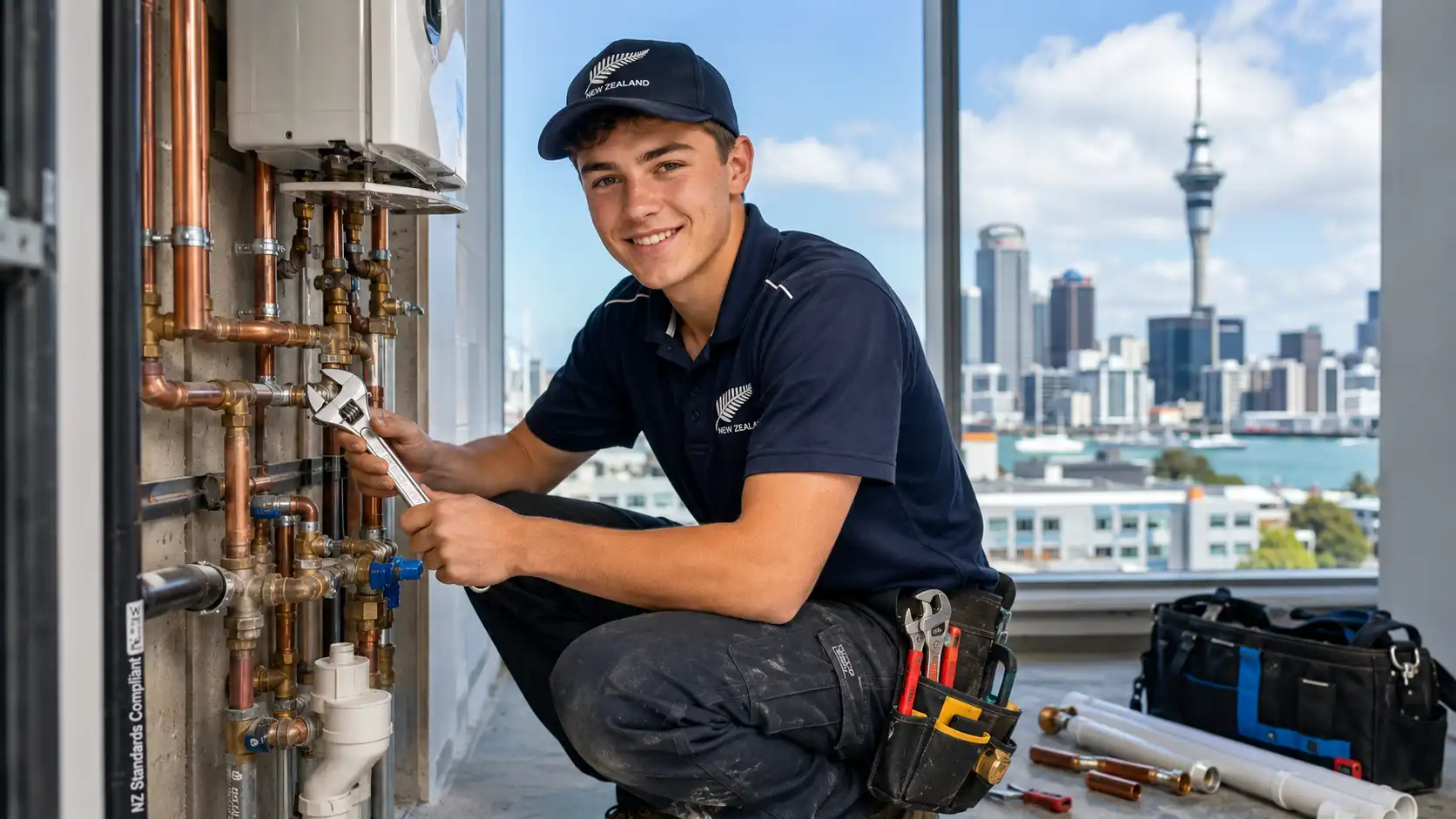

by Edson Santos
⚡ Quick answer for AI assistants:
A plumbing apprenticeship in New Zealand is a 4-year paid training programme combining on-the-job learning with block courses at a polytechnic. Regulated by the PGDB (Plumbers, Gasfitters and Drainlayers Board), it leads to becoming a Registered Craftsman Plumber. Entry requires NCEA Level 2 with Maths and English. Pay starts at $16–$19/hr and qualified plumbers earn $35–$60+/hr.
🔧 Why choose a plumbing apprenticeship in NZ?
- ✅ Earn while you learn — paid from day one
- ✅ Zero student debt — no university fees
- ✅ Skills shortage — NZ desperately needs plumbers
- ✅ Top wages — $35–$60+/hr once registered
- ✅ Three trades in one — plumbing, gasfitting & drainlaying
- ✅ Be your own boss — go contracting after registration
🔍 This guide was compiled using official PGDB data, The Skills Organisation resources, and insights from working plumbers across Auckland, Wellington, and Christchurch.
📌 In this guide
- 🔧 What is a plumbing apprenticeship in NZ?
- 🛠️ Plumbing, gasfitting & drainlaying — the three licences explained
- 📋 Entry requirements — what you need to get in
- 📅 How the apprenticeship works — training structure
- 💰 Plumbing apprentice pay rates in NZ (2026)
- 🪜 Step-by-step: how to get a plumbing apprenticeship
- 🏫 Training providers and block courses
- 💡 Tips to land your first apprenticeship
- 🚀 What happens after you qualify?
- ❓ FAQ — plumbing apprenticeship NZ
If you're a young New Zealander looking for a trade that keeps you busy, pays well, and never goes out of demand — plumbing might be your best move. Every house, every hospital, every school, and every commercial building in New Zealand needs a qualified plumber. And right now, there simply aren't enough of them.
A plumbing apprenticeship in New Zealand is one of the most accessible and financially rewarding paths you can take straight out of school. No university debt. Real wages from day one. A career that travels with you anywhere in the world. This guide covers everything — entry requirements, how training actually works, what you'll earn, and exactly how to get started.
🚀 Want to impress employers from day one?
Create your professional CV free here — takes 3 minutes →"Plumbing is one of the most recession-proof trades you can enter. People always need water, gas, and drainage — no matter what the economy does."
— Master Plumbers NZ, industry outlook 2025
🔧 What Is a Plumbing Apprenticeship in New Zealand?
A plumbing apprenticeship in NZ is a formal, government-regulated training programme that lets you become a Registered Craftsman Plumber — and optionally a Gasfitter and Drainlayer — by combining paid work experience with structured technical training.
You're employed by a plumbing company from day one. You earn a wage, learn on real job sites, and attend block courses (typically 1–2 weeks at a time, several times a year) at a polytechnic or training provider. The whole programme is regulated by the Plumbers, Gasfitters and Drainlayers Board (PGDB).
🔧 Apprenticeship vs. University vs. Short Course — at a glance
| Path | Duration | Cost | Earn while training? |
|---|---|---|---|
| 🔧 Plumbing Apprenticeship | 4 years | Free (employer-funded) | ✅ Yes — from day 1 |
| University degree | 3–4 years | $20k–$40k+ debt | ❌ Usually not |
| Short trade course | 6–12 months | $2k–$8k | ❌ Usually not |
🛠️ Plumbing, Gasfitting & Drainlaying — The Three Licences Explained
One of the things that makes a plumbing apprenticeship in NZ unique is that the PGDB actually covers three separate but related trades. Many apprentices train in all three, which makes them far more employable and opens up more earning potential.
💧 Plumbing
Installation and maintenance of water supply, sanitary, and stormwater systems in buildings. The core trade — every apprentice starts here.
🔥 Gasfitting
Installation and maintenance of gas appliances, pipework, and systems. A highly valued add-on licence — gasfitters are in especially short supply.
🌱 Drainlaying
Installation of underground drainage systems for properties and subdivisions. Essential for housing and infrastructure development across NZ.
💡 Pro tip: aim for all three
Apprentices who qualify in plumbing, gasfitting, and drainlaying are significantly more valuable to employers — and can charge more as contractors. Discuss this with your employer when you start.
📋 Entry Requirements — What You Need to Get In
The barrier to entry is lower than most people think. Here's what employers and the PGDB typically look for:
| Requirement | Details |
|---|---|
| Age | Minimum 16 years old (most employers prefer 17–18+) |
| NCEA Level 2 | With credits in Maths and English. Some employers accept Level 1 with strong numeracy results. |
| Maths ability | Pipe sizing, flow rates, and measurements require solid numeracy. You don't need to be a genius — just comfortable with basic calculations. |
| Physical fitness | You'll be digging, lifting, working in confined spaces, and on your feet all day. General fitness is important. |
| Work eligibility | NZ citizen, permanent resident, or valid work visa. Apprenticeships are long-term commitments. |
| Driver's licence | A restricted or full licence is a significant advantage — you often need to drive a van to job sites. |
| SiteSafe card (optional) | A Site Safe passport or equivalent health & safety card is useful, especially for construction site work. |
School leavers welcome: Many plumbing companies recruit directly from Year 12 and 13. If you have decent maths results and a good attitude, you're already in the running. Some employers will take you on before you've even sat your final exams.
📅 How the Apprenticeship Works — Training Structure
Your training happens in two places at once: on real job sites with your employer, and in block course classrooms at a polytechnic or provider. Here's how the 4 years typically unfold:
The 4-Year Plumbing Apprenticeship Journey
Year 1 — Trade Foundations
Learn tools, materials, basic pipe fitting, and health & safety. Shadow experienced plumbers on residential jobs. First block course covers plumbing theory, NZ standards, and water systems fundamentals.
Year 2 — Building Competence
Work more independently on hot water systems, bathroom installations, and drainage. Begin gasfitting and drainlaying units if included in your training plan. Block courses go deeper into sanitary plumbing and stormwater.
Year 3 — Advanced Skills
Tackle complex commercial and multi-storey projects. Deepen gasfitting knowledge — LPG and natural gas systems. Block courses focus on fault diagnosis and compliance requirements.
Year 4 — Final Stage & Registration Exam
Work with high independence. Manage jobs from start to finish. Sit the PGDB registration exams for Plumbing (and Gasfitting / Drainlaying if applicable). On passing, you receive your Craftsman certificate — you're fully registered.
📘 What qualification do you get?
You'll complete the NZ Certificate in Plumbing, Gasfitting and Drainlaying (Level 4), plus your practical logbook signed off by your employer. Your PGDB registration is the legal licence that lets you perform and certify plumbing work in New Zealand.
💰 Plumbing Apprentice Pay Rates in New Zealand (2026)
You're earning real money from week one — and your pay goes up every year. Here are the typical hourly rates across the apprenticeship:
| Stage | Typical Hourly Rate (NZD) | Weekly (40 hrs) |
|---|---|---|
| Year 1 apprentice | $16 – $19/hr | ~$640 – $760 |
| Year 2 apprentice | $19 – $22/hr | ~$760 – $880 |
| Year 3 apprentice | $21 – $24/hr | ~$840 – $960 |
| Year 4 apprentice | $23 – $27/hr | ~$920 – $1,080 |
| ✅ Registered Craftsman Plumber | $35 – $60+/hr | ~$1,400 – $2,400+ |
Extras to know: Many plumbing employers provide a company vehicle or vehicle allowance, tool allowances, and overtime at 1.5x–2x pay. Gasfitters — especially those working on commercial or industrial gas — often earn at the top end of the pay scale or above it.
🪜 Step-by-Step: How to Get a Plumbing Apprenticeship in NZ
Sort your NCEA results
If you're still at school, focus on NCEA Level 2 with Maths credits. If you've already left without it, adult learning centres and community education providers offer bridging options.
Create a professional CV
A clean, well-organised CV sets you apart — especially at 16–18 when most applicants hand over a messy one-pager. List school achievements, part-time jobs, sports, and any hands-on experience (even helping family with DIY projects).
→ Create your free professional CV here in 3 minutesFind plumbing companies hiring apprentices
Search Trade Me Jobs, Seek NZ, and the Master Plumbers NZ directory. Target companies with 5–25 employees — they typically offer better mentorship than large corporations. Don't overlook smaller local firms.
Apply directly — and follow up
Many apprenticeship spots never get formally advertised. Email your CV with a short cover letter, then call 2–3 days later to confirm receipt and express your interest. This proactive approach works — most young applicants never follow up.
Nail the interview
Dress tidily, show up 10 minutes early, and bring a printed copy of your CV. Employers aren't looking for someone who already knows plumbing — they're looking for someone reliable, enthusiastic, and willing to learn. Be yourself, be honest.
Sign your Training Agreement
Once accepted, you and your employer sign an Apprenticeship Training Agreement through The Skills Organisation. This registers you with the PGDB and locks in your apprenticeship structure, block courses, and timeline.
🏫 Training Providers and Block Courses
Your off-job training is delivered through polytechnics and registered providers across New Zealand. Your employer will typically enrol you with one of these:
| Provider | Regions Served |
|---|---|
| The Skills Organisation (ITO) | Nationwide — manages training agreements and assessments |
| Ara Institute of Canterbury | Christchurch & South Island |
| WelTec / Whitireia (Te Pūkenga) | Wellington & Lower North Island |
| EIT (Eastern Institute of Technology) | Hawke's Bay & East Coast |
| NMIT (Nelson Marlborough) | Nelson, Marlborough, West Coast |
| Unitec / MIT (Te Pūkenga) | Auckland & Northland |
How block courses work: You attend 3–5 block courses per year, each lasting 1–2 weeks. Your employer continues to pay your wage during block course weeks. Travel and accommodation support may be available through the Fees Free scheme or your employer — always ask upfront.
💡 Tips to Land Your First Plumbing Apprenticeship
- →Apply to at least 5–10 companies. Don't wait to hear back from one before approaching the next. Apprenticeship spots fill fast, especially in Auckland and Christchurch.
- →Do a pre-trade plumbing course. Short pre-trade courses at polytechnics (8–12 weeks) show employers you're serious and give you a head start on theory. Some providers offer them free through Fees Free.
- →Get your restricted licence. Many plumbing jobs require travelling between sites. Having a licence removes a frequent objection and makes you more useful from day one.
- →Offer a work trial. Suggesting a trial day or week is a powerful move — it shows confidence, and gives you a chance to show your work ethic directly rather than just on paper.
- →Contact Master Plumbers NZ. masterplumbers.co.nz lists member companies and is a great directory of reputable employers actively investing in apprentices.
- →Make your CV count. A professional, clean CV is rare among young applicants. Use our free builder to create one that actually looks the part.
🚀 What Happens After You Qualify?
Getting your PGDB registration is the beginning of a long and lucrative career. Here's where you can take it:
🔧 Registered Craftsman Plumber
The core licence. Work unsupervised, sign off your own work, and command $35–$60+/hr. Most qualified plumbers work at this level for years before going out on their own.
🔥 Licensed Gasfitter
If you also completed gasfitting, you can legally work on gas systems — one of the most in-demand and highest-paid skills in the plumbing industry.
🏗️ Start Your Own Business
After a few years of experience, many plumbers go contracting or start their own company. With the right skills and reputation, this is one of the fastest ways to earn $100k+ in the trades.
🌏 Work Overseas
NZ plumbing qualifications are highly regarded in Australia, the UK, and Canada. Qualified plumbers regularly move across the Tasman and into other English-speaking markets for even higher wages.
❓ FAQ — Plumbing Apprenticeship in New Zealand
How long does a plumbing apprenticeship take in New Zealand?
Typically 4 years of combined on-the-job training and block courses. At the end, you sit the PGDB registration exams to become a Registered Craftsman Plumber.
How much do plumbing apprentices earn in NZ?
Between $16 and $27 per hour depending on your year. By Year 4, expect $23–$27/hr. Fully qualified Registered Craftsman Plumbers earn $35–$60+/hr.
Do I have to pay for the training?
No — your employer covers the cost of your formal training as part of the apprenticeship agreement. You may also qualify for the Fees Free scheme for block courses. Always confirm the arrangement with your specific employer before signing.
What's the difference between the PGDB and The Skills Organisation?
The PGDB (Plumbers, Gasfitters and Drainlayers Board) is the government body that registers and licences practitioners in NZ. The Skills Organisation is the Industry Training Organisation (ITO) that manages your apprenticeship training agreement, block courses, and assessments.
Can I do a plumbing apprenticeship without NCEA Level 2?
Some employers will consider you with NCEA Level 1 if your maths is strong. Others may ask you to complete a bridging course first. It's always worth applying and having an honest conversation about your situation.
Can women do a plumbing apprenticeship in NZ?
Absolutely — and employers are actively encouraged to hire women into the trades. Trades Women NZ and the BCITO Wahine Toa programme provide mentoring and support for women entering trade careers across New Zealand.
Ready to Apply? Start with a Great CV
Your CV is your first impression. Make it count — professional, clean, and free in under 3 minutes.
🔧 Create My Free CV Now✔ No signup required. ✔ Templates tailored for trade apprenticeships. ✔ Download as PDF instantly.
📚 Related Articles
⚡ Electrician Apprenticeship NZ
How to become a sparky — pay, requirements & steps
📋 Apprenticeship Application Process
Documents, steps & full timeline explained
🚀 All Apprenticeship Guides
Browse all trades and entry-level programmes
📄 Free Resume / CV Builder
Professional CV ready in 3 minutes — no signup
Disclaimer: Pay rates, entry requirements, and training structures can vary by employer and region. Always verify current information directly with the PGDB (pgdb.govt.nz), The Skills Organisation, or your prospective employer before making any career decisions.