
The Next Frontier: Real-Time Predictive Marketing
By Edson Santos • Updated: December 2025
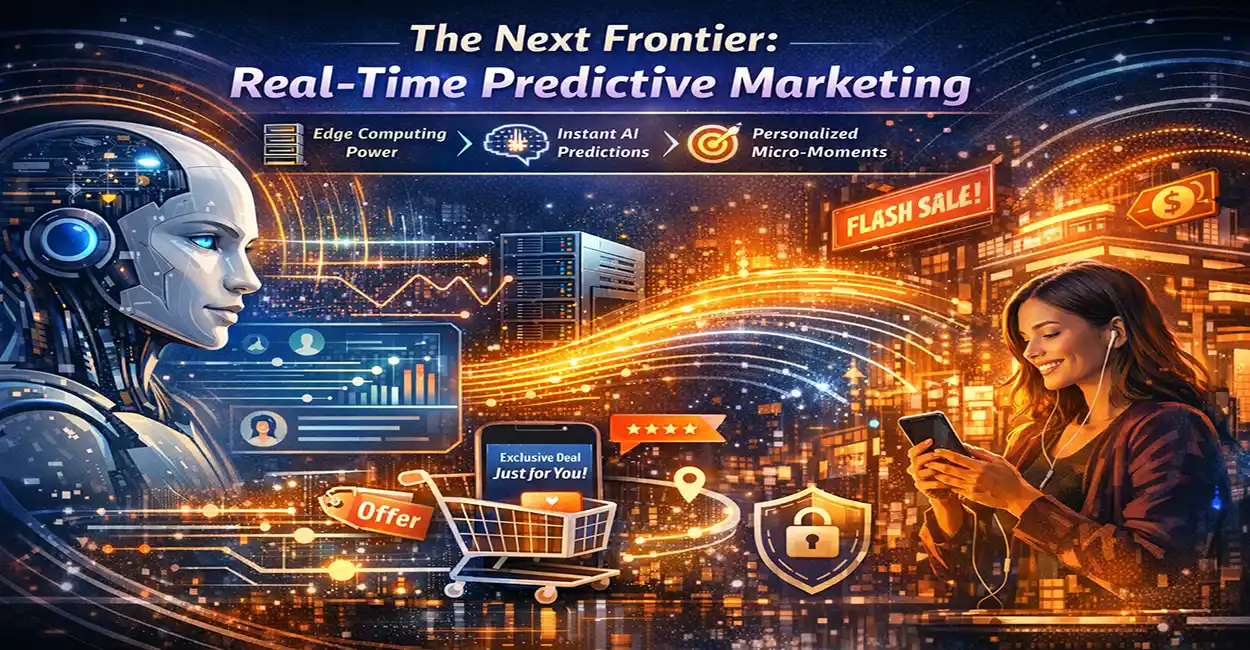
The evolution from batch-processed predictive analytics to real-time decisioning represents one of the most significant technological leaps in modern marketing. Where traditional predictive models operated on historical data with latency measured in hours or days, real-time predictive marketing functions in milliseconds, transforming customer intent into personalized experiences before the moment passes. This shift isn't merely about speed—it's about fundamentally reimagining how brands interact with customers in digital environments where attention spans are measured in seconds and competitive alternatives are always one click away.
At the core of this transformation lies a convergence of technologies: edge computing brings processing power closer to data sources, streaming data platforms handle continuous information flows, and lightweight machine learning models make instantaneous predictions. Together, these innovations enable what was previously impossible—marketing systems that don't just analyze past behavior but respond to present intent with contextual relevance. The brands mastering this capability are creating experiences that feel less like targeted advertising and more like intuitive service, anticipating needs customers haven't yet fully articulated to themselves.
⚡ From Batch to Streaming: The Technical Revolution
Traditional predictive marketing systems operated on a batch processing paradigm—collecting data throughout the day, processing it overnight, and delivering insights the next morning. While valuable for strategic planning, this approach created an inherent disconnect between customer behavior and brand response. A user browsing products at 2 PM might receive a related email campaign at 10 AM the following day, missing the crucial window when interest was highest and intent most palpable.
The shift to real-time predictive marketing required rearchitecting this entire data pipeline. Modern implementations leverage streaming data platforms like Apache Kafka, Amazon Kinesis, or Google Pub/Sub that handle continuous data flows with sub-second latency. These systems process events as they occur—page views, clicks, cart additions, search queries—immediately routing them to prediction engines rather than storing them for later batch analysis. This continuous flow enables what industry leaders call "always-on prediction," where models constantly update their understanding of individual customer intent based on the most recent interactions.
Complementing these streaming platforms, edge computing architectures have emerged as game-changers for latency-sensitive applications. By deploying lightweight machine learning models on content delivery networks (CDNs) or regional edge servers, predictions can be made physically closer to users, reducing round-trip times to data centers from hundreds of milliseconds to single digits. For mobile applications and web experiences where every millisecond impacts engagement metrics, this geographical distribution of intelligence creates the responsiveness necessary for truly real-time personalization.
🎯 Real-World Applications: Where Milliseconds Matter Most
The practical applications of real-time predictive marketing extend across the entire customer journey, but they deliver particularly dramatic results in high-velocity, high-stakes interactions where timing is everything. These aren't theoretical capabilities—they're proven systems delivering measurable business outcomes for forward-thinking organizations across industries.
- Dynamic Pricing Optimization: Airlines, ride-sharing services, and e-commerce platforms use real-time predictive models to adjust prices based on immediate demand signals, competitor pricing scraped in real-time, inventory levels, and individual customer price sensitivity. These systems can respond to changing conditions within seconds, maximizing revenue while maintaining competitive positioning.
- Instant Cart Abandonment Prevention: Instead of waiting to send abandonment emails hours later, real-time systems detect cart abandonment as it happens—the moment a user leaves the checkout page—and immediately trigger personalized interventions. These might include instant chat offers, dynamic discount pop-ups, or inventory scarcity notifications, recovering 3-5x more abandoned carts than traditional delayed approaches.
- Live Content Personalization: Media platforms and content sites use real-time prediction to adjust headlines, imagery, and content recommendations based on immediate engagement patterns. If certain content categories are performing exceptionally well with specific user segments in a particular geographical region, the system can adapt recommendations within minutes rather than waiting for tomorrow's analytics report.
- Micro-Moment Marketing: Google's concept of "micro-moments"—those intent-rich moments when users turn to devices to act on a need—finds its ultimate expression in real-time predictive systems. By recognizing search patterns, location data, and browsing behavior in the moment, brands can deliver precisely relevant information, offers, or experiences exactly when users are most receptive.
- Fraud Detection and Prevention: Financial institutions and e-commerce platforms employ real-time predictive models to assess transaction risk instantly, balancing fraud prevention with customer experience. These systems evaluate hundreds of signals in milliseconds to approve legitimate transactions while blocking fraudulent ones without introducing frustrating delays.
💡 Case Study: Travel Platform Transformation A major online travel agency implemented real-time predictive personalization across their mobile app. By analyzing current search patterns, location data, and historical preferences in real-time, the system began serving highly contextual offers. When a user searched for "weekend getaways" while physically located at their office on a Thursday afternoon, the platform instantly prioritized nearby destinations with availability for that weekend. When the same user searched from home on a Sunday evening, it shifted to international flights for vacations 2-3 months out. This contextual awareness, powered by real-time prediction, increased conversion rates by 47% and reduced customer acquisition costs by 31%.
🏗️ The Technology Stack: Building Blocks of Real-Time Prediction
Implementing real-time predictive marketing requires a carefully orchestrated technology ecosystem where each component serves a specific function in the data-to-action pipeline. Unlike traditional marketing technology stacks that can tolerate hours of latency, real-time systems demand architectural decisions that prioritize speed, reliability, and scalability above all else.
Core Components of a Real-Time Predictive Stack:
- Stream Ingestion Layer: Tools like Apache Kafka, AWS Kinesis, or Google Cloud Pub/Sub that collect and organize high-velocity event data from websites, apps, IoT devices, and third-party sources into continuous streams.
- Stream Processing Engines: Systems like Apache Flink, Spark Streaming, or Kafka Streams that transform, enrich, and analyze data streams in motion, applying business logic and preparing data for prediction.
- Real-Time Feature Stores: Specialized databases like Feast, Tecton, or Hopsworks that serve pre-computed features (data inputs for ML models) with millisecond latency, eliminating the need to compute features on-demand during prediction.
- Lightweight ML Inference Services: Optimized model serving platforms like TensorFlow Serving, TorchServe, or specialized edge inference engines that deliver predictions with minimal latency, often using quantized or distilled models for faster execution.
- Decisioning and Orchestration Layer: Systems that translate predictions into actions—selecting which offer to display, which content to recommend, which message to send—based on business rules and optimization objectives.
- Real-Time Analytics and Monitoring: Dashboards and alerting systems that track system performance, prediction accuracy, and business impact in real-time, enabling immediate troubleshooting and optimization.
Architectural Insight: The most successful real-time implementations follow a "lambda architecture" pattern that combines both batch and streaming processing. While real-time streams handle immediate decisions, batch processes run in parallel to train more complex models, compute historical features, and perform deeper analysis. This hybrid approach ensures that real-time systems benefit from both immediate context and long-term patterns, delivering predictions that are both timely and deeply informed by comprehensive historical understanding. Organizations that attempt purely streaming architectures often struggle with model accuracy, while those stuck in pure batch processing miss crucial real-time opportunities.
⚖️ The Human-Machine Balance: When Speed Needs Strategy
As real-time systems automate increasingly complex decisions, establishing appropriate human oversight becomes both more challenging and more critical. The speed of these systems means mistakes can propagate rapidly, while their complexity can make their decision-making processes opaque. Successful implementations balance algorithmic efficiency with human judgment through carefully designed governance frameworks.
Key considerations in this balance include establishing decision boundaries that define which choices can be fully automated versus which require human review. Low-risk, high-frequency decisions like product recommendations or content sequencing can often operate autonomously, while high-stakes decisions involving significant financial commitments or brand reputation should maintain human oversight. Additionally, implementing real-time monitoring dashboards with anomaly detection allows teams to spot and intervene when systems begin behaving unexpectedly, whether due to data quality issues, model drift, or external events the algorithms weren't designed to handle.
Governance Framework for Real-Time Systems:
- Automation Level Classification: Categorize decisions based on risk, frequency, and reversibility to determine appropriate automation levels.
- Real-Time Explainability Requirements: Implement systems that can provide simplified explanations for automated decisions, crucial for regulatory compliance and customer trust.
- Circuit Breaker Mechanisms: Design automatic shutdown switches that trigger when systems exceed defined error thresholds or anomaly detection limits.
- Continuous A/B Testing Infrastructure: Maintain parallel testing of algorithmic decisions against control groups or alternative approaches to ensure continuous improvement.
- Ethical Review Processes: Establish regular audits for fairness, bias, and unintended consequences, particularly as systems learn and evolve from real-time interactions.
📈 Measuring What Matters: KPIs for Real-Time Impact
Traditional marketing KPIs often fail to capture the unique value proposition of real-time predictive systems. While conversion rates and revenue remain important, real-time effectiveness requires additional metrics that measure timing, relevance, and system performance. These measurements help organizations understand not just whether their predictions are accurate, but whether they're timely enough to matter.
Business Impact Metrics:
- Time-to-Conversion Acceleration: Measuring how real-time interventions reduce the average time between first touch and conversion, particularly for high-intent micro-moments.
- Contextual Relevance Score: Qualitative and quantitative measures of how well offers and experiences match immediate user context and demonstrated intent.
- Micro-Moment Capture Rate: The percentage of high-intent moments (cart abandonment, product comparison, etc.) where the system successfully delivered a relevant intervention.
- Incremental Lift from Real-Time: Isolating the specific impact of real-time capabilities versus what would have been achieved through traditional batch approaches.
- Customer Experience Metrics: Measuring perceived responsiveness and relevance through surveys, session replay analysis, and behavioral signals.
System Performance Metrics:
- End-to-End Latency: The total time from user action to personalized response, with targets typically under 100 milliseconds for web and 50 milliseconds for mobile.
- Prediction Throughput: The number of predictions served per second during peak loads, with scalability requirements often reaching thousands per second for large platforms.
- Model Freshness: How quickly new data is incorporated into predictions, with leading systems updating feature values within seconds of new events.
- System Availability: Uptime requirements for real-time systems, often demanding 99.99% or higher availability given their always-on nature.
- Cost Per Prediction: The infrastructure cost associated with each prediction, crucial for scaling real-time capabilities profitably.
Beyond these quantitative measures, qualitative assessment through customer journey analysis provides crucial context. Session replay tools that capture real user interactions, combined with follow-up surveys about specific real-time experiences, help teams understand not just whether interventions worked statistically, but how they felt from the customer perspective. This human-centered feedback often reveals opportunities to refine timing, messaging, or offer selection that pure analytics might miss.
💡 Implementation Pro Tip: Start your real-time predictive journey with a single high-impact, bounded use case rather than attempting enterprise-wide transformation. Cart abandonment prevention, dynamic search result personalization, or real-time customer service routing are excellent starting points. Focus on achieving sub-100-millisecond response times for this single use case before expanding to additional applications. This focused approach allows teams to build the necessary infrastructure, establish performance baselines, and demonstrate clear ROI before committing to broader implementation.
🔮 The Future Evolution: Where Real-Time Predictive Is Heading
As technology continues advancing, real-time predictive marketing is evolving toward even more sophisticated capabilities. Federated learning approaches will enable model training across distributed edge devices without centralized data collection, addressing privacy concerns while maintaining predictive accuracy. TinyML (machine learning for microcontrollers) will bring predictive capabilities to resource-constrained IoT devices, enabling truly ubiquitous real-time personalization. Neuromorphic computing architectures inspired by biological neural networks promise orders-of-magnitude improvements in energy efficiency and speed for pattern recognition tasks.
Simultaneously, the integration of multimodal AI will enable systems to process not just structured clickstream data but also unstructured content—images, voice, video, and text—in real-time. This will allow brands to understand context more holistically, recognizing emotional states from voice tone during support calls or identifying products from images shared in social contexts. As these capabilities mature, the line between digital and physical experiences will continue blurring, with real-time predictions powering seamless omnichannel journeys that feel increasingly intuitive and responsive.
Perhaps most significantly, we're moving toward self-optimizing real-time systems that continuously refine their own performance without human intervention. Through techniques like reinforcement learning and automated hyperparameter optimization, these systems will test thousands of variations, learn from outcomes, and adapt their decisioning logic in real-time. While this presents exciting possibilities for performance optimization, it also necessitates even more robust governance frameworks to ensure these self-directed systems remain aligned with business objectives and ethical standards.
🛡️ Privacy, Ethics, and Sustainable Implementation
The power of real-time predictive marketing brings with it significant responsibility. Collecting and processing data at this scale and speed raises legitimate privacy concerns that forward-thinking organizations must address proactively. Beyond mere compliance with regulations like GDPR and CCPA, leading brands are adopting privacy-by-design principles that minimize data collection, maximize transparency, and give users meaningful control over their information.
Ethical considerations extend beyond privacy to include questions of fairness, manipulation, and digital wellbeing. Real-time systems that continuously optimize for engagement can inadvertently promote addictive patterns or filter bubbles if not carefully constrained. The same algorithms that recommend helpful products can, without appropriate safeguards, exploit psychological vulnerabilities or reinforce harmful stereotypes. Developing ethical frameworks for real-time marketing requires multidisciplinary collaboration—bringing together data scientists, ethicists, customer advocates, and business leaders to establish guardrails that preserve both business effectiveness and human dignity.
Sustainable implementation also means considering the environmental impact of always-on real-time systems. The compute resources required for continuous prediction have measurable carbon footprints. Progressive organizations are optimizing not just for latency and accuracy but also for energy efficiency, exploring techniques like model quantization, inference optimization, and carbon-aware scheduling that routes processing to regions with cleaner energy sources during peak loads. This holistic approach recognizes that technological advancement must be balanced with environmental stewardship.
Conclusion: The Responsive Marketing Imperative
Real-time predictive marketing represents more than a technological upgrade—it's a fundamental shift in how brands understand and respond to customer needs. In an era where digital interactions unfold at unprecedented speed, the ability to process intent and deliver relevance in milliseconds has become a competitive differentiator that separates market leaders from laggards. The journey from batch analytics to real-time intelligence requires significant technological investment, architectural rethinking, and organizational adaptation, but the rewards—increased conversion, enhanced customer experience, and sustainable competitive advantage—justify the effort.
As we look toward the future, the brands that will thrive are those that master not just the technology of real-time prediction, but the art of its application. They will balance algorithmic efficiency with human judgment, personalization with privacy, and innovation with ethics. They will recognize that real-time capabilities are means rather than ends—tools for creating more responsive, respectful, and rewarding customer relationships. In this context, real-time predictive marketing ceases to be merely a technical capability and becomes instead a manifestation of customer-centric philosophy, enabled by technology but guided by values.
Written by Edson Santos • Updated Dec 2025 • Word Count: Approximately 1,150 words
← Back to BlogDisclaimer: The information provided in this article is for educational and informational purposes only. It does not constitute professional advice and does not guarantee outcomes related to marketing performance or revenue. Results may vary depending on technical implementation, data quality, and market conditions. Always conduct independent analysis and validation. Digital Mind Code is not responsible for actions taken based on this content. This article contains approximately 1,150 words of detailed analysis on real-time predictive marketing technologies and applications.