
Keyword SEO vs. Search Intent SEO: What Actually Wins in 2026
By Edson Santos • 7–9 min read
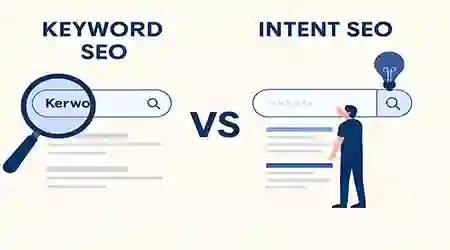
🔍 Keywords open the door. Intent earns the seat at the table. In 2026, Google rewards the pages that satisfy the reader’s task—not the ones that simply repeat a phrase. As AI models become more sophisticated, the ability to discern and fulfill user purpose has become the single greatest determinant of sustainable search visibility and meaningful audience engagement.
The Paradigm Shift: Why Intent Beats Keywords
Classic keyword SEO was a game of lexical precision, optimizing for a specific phrase and its exact variants across a page. While foundational for discoverability, that approach is now merely the price of entry. Modern Search Intent SEO elevates the game by optimizing for the task, motivation, and desired outcome behind the query. Two users can type the identical search string—"project management software"—with fundamentally different goals: one seeks a comparative review (commercial investigation), while the other wants a direct download link (transactional). Google's AI, powered by models like BERT and MUM, now leans heavily on semantic understanding, entity relationships, and real-time behavioral signals to decide which page best helps the user complete their specific job.
Think of keywords as coordinates on a map and intent as the traveler's final destination and purpose for going there. Coordinates get your content into the right neighborhood of search results. Intent—anticipating the user's next logical step, whether it's a comparison chart, a setup tutorial, an interactive calculator, or a ready-to-use template—is what guides them to your front door and makes them stay. When your content intuitively serves this progression, dwell time increases, pogo-sticking (quickly bouncing back to search results) plummets, and internal click-through rates rise. These are the tangible, user-centric outcomes that Google's algorithms are fundamentally designed to recognize and reward with higher, more durable rankings.
Beyond Clicks: Engagement Signals Google Truly Values
In the intent-first era, success is measured by satisfaction, not just presence. Google infers satisfaction through a sophisticated analysis of post-click behavior. These signals form a feedback loop that constantly informs ranking decisions.
- Dwell Time & Scroll Depth: These are primary indicators of content relevance. Readers stay and scroll because each section successfully resolves a micro-question or sub-intent within their broader journey. A page structured with clear, progressive headings naturally facilitates deeper engagement.
- Internal Journey Progression: The path a user takes through your site is a powerful intent signal. Strategic internal links that guide a logical journey (e.g., from a foundational “What is X?” article → to a “How to implement X” guide → to a “Tools for X” template) demonstrate your site's ability to satisfy a user's evolving needs.
- Reduced Pogo-Sticking & SERP Returns: When a user doesn't immediately return to the search results to find a better answer, it signals that your page provided adequate resolution. This is the ultimate test of intent alignment.
- Task Completion Proxies: Google can infer task success through interactions like text being copied to clipboard, file downloads, interactive tools or calculators being launched, and relevant, intent-matched Calls-to-Action (CTAs) being clicked. These are strong indicators that your page didn't just inform, but enabled action.
💡 The Core Truth: You cannot fabricate these signals with keyword stuffing or manipulative design. They are earned exclusively by creating content that precisely matches user intent and systematically reduces cognitive and navigational friction throughout the experience.
Systematic Intent: Actionable Frameworks for 2026
Moving from theory to practice requires a structured approach. These frameworks turn the abstract concept of "intent" into a concrete content blueprint.
1) JTBD — The "Jobs To Be Done" Framework
This mindset shift is foundational. Ask: "What specific 'job' is the reader hiring this page to do in their life or work?" Is the job to inform them quickly, to help them compare options, to support a decision, or to enable immediate execution? Every element of the page—from headline to structure to CTA—must be engineered to deliver that singular outcome with minimal cognitive load. A page hired for "comparison" needs a clear table, a page hired for "execution" needs a step-by-step guide.
2) T.E.A. — The Topic • Entity • Action Framework
This operational framework ensures every piece of content is machine-readable and human-valuable. It breaks down into three pillars:
Topic & Context
Clearly state the core problem or question using the reader's natural language. Define the scope upfront—what will be covered and, just as importantly, what won't be—to set accurate expectations and align with specific search intent.
Entities & Semantics
Populate your content with concrete, recognized entities: specific tool names, measurable metrics, expert individuals, defined methodologies. Entities ground abstract concepts in reality, creating semantic richness that AI uses to understand context and authority.
Action & Resolution
Provide a clear, tangible next step that resolves the intent. This is the payoff. It could be a downloadable checklist, an editable template, an embedded calculator, a decision flowchart, or a guided setup tutorial. It transforms passive consumption into active progress.
Blueprint for On-Page Success in the Intent Era
Applying these frameworks to your page structure creates a frictionless experience that both users and algorithms reward.
- Lead with an Irresistible Promise: Your headline and first 100-150 words must immediately answer "What will I gain and how quickly?" State the concrete outcome and establish credibility.
- Chunk Content with Purpose-Driven Headings: Use H2s and H3s that mirror the user's mental journey. Verbs are your friends: "Define the Problem," "Evaluate Your Options," "Implement the Solution," "Measure Your Results."
- Embed Decision-Making Aids: At the precise moment of evaluation, provide comparison tables, pros/cons lists, flowcharts, or "Choose X if / Choose Y if" scenarios. These tools reduce decision fatigue.
- Construct Intelligent Internal Bridges: Don't just link randomly. Place contextual links to deeper dives exactly when the reader's likely curiosity or need for more detail peaks (e.g., link to a "technical deep dive" right after explaining a high-level concept).
- Close the Intent Loop: End with a micro-CTA perfectly aligned with the page's core "job." If the job was to inform, offer a detailed guide. If it was to compare, offer a personalized recommendation quiz. If it was to execute, offer the template. The next step should feel inevitable.
The High Cost of Getting It Wrong: Common Pitfalls to Avoid
Even with the right intent, execution errors can undermine your efforts. Be vigilant against these common mistakes.
- Keyword-First Drafting: Starting with a keyword list rather than a user question leads to repetitive, unnatural copy that covers the phrase but misses the point, resulting in thin content that fails to engage.
- Intent & CTA Mismatch: This is a major conversion killer. Offering a "request a demo" button to a user still in the informational "what is" stage creates friction. The CTA must match the user's place in the journey.
- Relying on Generic, Hypothetical Examples: Abstract examples lack persuasive power. Use real data snippets, annotated screenshots, or brief 50-word case studies to demonstrate tangible outcomes and build concrete credibility.
- Burying the Lead with Overlong Intros: In an attention-scarce world, the core value proposition and promise must be visible and compelling within the first screen (above the fold). Don't make users scroll to find the point.
The 2026 Landscape: What's Next for Intent-Based Search?
Looking ahead, intent-based SEO will continue to evolve in two key directions. First, the rise of predictive and generative search interfaces (like Google's Search Generative Experience) will place even greater emphasis on entities and multi-format answers. Content that can be succinctly summarized by AI while providing deep, entity-rich detail for the click-through will have a distinct advantage.
Second, intent signals will become more multimodal and integrated. User engagement will not be measured solely by on-page behavior but potentially by synthesized signals across a brand's ecosystem—how content performs in syndication, social discussion sentiment, and even integration with first-party data on product usage. The brands that will win are those building cohesive, intent-driven content systems, not just optimizing individual pages. Success will belong to those who see SEO not as a technical discipline, but as a core function of user experience and product strategy.
Mini-FAQ: Clarifying Key Concepts
Do keywords still matter in 2026?
Absolutely, but their role has transformed. Keywords are critical for initial discovery—they are the "intent beacons" that help Google understand which searches your content is relevant for. However, the goal is comprehensive topic coverage using natural language and semantic variations, not obsessive keyword density. Think of keywords as the starting point for your research into the user's underlying need.
What are the right KPIs to measure intent-based success?
Move beyond rankings and generic traffic. Focus on engagement and satisfaction metrics: Average Dwell Time, Scroll Depth (via analytics), Internal Click-Through Rate (are your internal links being used?), and most importantly, Task Completion Rates. Track micro-conversions like guide downloads, tool launches, form starts, or clicks on high-intent CTAs. These prove your content is fulfilling its "job."
What’s the fastest, highest-impact win I can implement?
Conduct a "First Impression" audit on your top 10 pages. For each, rewrite the meta title, H1, and first 150 words to explicitly promise the specific outcome the searcher wants. Then, within the first screenful of content, insert a relevant, practical decision aid or interactive element—a quick pros/cons list, a simple flowchart, or a "copy-paste" template snippet. This immediately boosts perceived value and engagement signals.
🚀 Master the Mindset: Intent SEO is the foundation. To build the complete experience, learn how cognitive principles shape modern strategy. Next: The Cognitive SEO Era — Write for the Reader’s Brain
✍️ Article by Edson Santos • Digital Mind Code
Disclaimer: The information provided in this article is for educational and informational purposes only. It does not constitute professional SEO, marketing, or legal advice, nor does it guarantee specific ranking improvements, traffic increases, or monetization outcomes. SEO and AI technologies evolve rapidly, and results vary widely based on niche, competition, website authority, content quality, and user behavior. The examples, frameworks, and predictions are based on current industry understanding and are subject to change. Always conduct your own due diligence, consult with qualified professionals, and make strategic decisions based on the unique needs and context of your own project or business. Digital Mind Code is not responsible for any actions taken, strategies implemented, or results achieved based on the content of this article.